

01.Client Overview
An industrial manufacturer supplying equipment and components to construction, utilities, and industrial operators was expanding its production capabilities in the UAE while aiming to improve tender success rates across UAE and Saudi Arabia.
While the company had strong technical capabilities, it faced increasing competition in high-value bids where competitors were strengthening their localization positioning and procurement alignment.
The client needed a deeper understanding of:
- How procurement teams evaluate suppliers
- What localization factors influence tender decisions
- How pricing, lead time, and service capabilities impact buyer preferences
The objective was to develop a localization roadmap and bid strategy aligned with regional industrial priorities and local-content expectations.
02.Business Problem / Objective
The client was experiencing bid losses due to three major challenges:
Limited Localization Proof
Competitors were gaining an advantage by demonstrating stronger local presence and localization capabilities.
The client needed to understand the difference between:
- Meaningful localization backed by operational capability
- Minimal localization claims with limited procurement value
Incomplete Procurement Stakeholder Mapping
Industrial buying decisions involved multiple stakeholders, each with different priorities.
The client required a clearer understanding of:
- Procurement evaluation criteria
- Engineering requirements
- Financial considerations
- Project execution priorities
Misaligned Price and Lead-Time Trade-offs
Different buyer groups evaluated value differently.
Some buyers prioritized commercial competitiveness, while others valued:
- Faster delivery
- Reliable service support
- Lower operational risk
The objective was to create buyer-specific bid strategies to improve tender performance.
03.Research Approach (Primary + Secondary)
Researchers.me combined market intelligence, procurement analysis, and primary B2B research to identify the key drivers influencing industrial supplier selection.
Market Context
The research considered regional industrial strategies, including:
- UAE’s Operation 300bn initiative, which aims to increase the industrial GDP contribution
- Saudi Arabia’s Vision 2030 industrial development priorities
- Local-content requirements influencing procurement decisions
Fieldwork period: 12 Aug 2025 – 3 Oct 2025
Primary Research
Tender & Procurement Intelligence
Analysis of:
- 3 years of public tender data
- Client bid history
- Procurement evaluation patterns
The analysis identified:
- Bid performance gaps
- Competitor positioning
- Compliance improvement opportunities
B2B Stakeholder Interviews
Sample size: n = 32
Interviews were conducted with stakeholders across UAE and Saudi Arabia, including:
- Procurement teams
- Engineering professionals
- Finance stakeholders
- Project management teams
The research explored:
- Supplier selection criteria
- Localization expectations
- Service requirements
- Commercial decision drivers
Distributor & Channel Assessment
11 partners evaluated
Partners were assessed on:
- Market coverage
- Compliance readiness
- Delivery capability
- After-sales support
Buyer Preference & Trade-Off Analysis
Discrete choice experiment: n = 146 B2B respondents
The study evaluated buyer willingness to trade between:
- Price
- Lead time
- Service capability
- Local presence
Localization Readiness Audit
A BOM-level assessment was conducted to identify feasible localization opportunities within a 12–18 month roadmap.
04.Key Findings
Localization Is Viewed as a Spectrum
The research revealed that buyers differentiate between two types of localization.
Real Localization
Buyers placed higher value on suppliers with:
- Local assembly capability
- In-country testing
- Regional service support
- Long-term operational presence
Label Localization
Limited assembly or cosmetic localization created weaker procurement impact.
The finding highlighted that credibility comes from demonstrated local capability, not only localization claims.
05.Buyer Priorities Differ by Segment
Government-Linked Buyers
These buyers placed stronger importance on:
- Local-content documentation
- Compliance readiness
- Regional presence
For these opportunities, proving localization capability was a key competitive factor.
Private Industrial Operators
Private operators prioritized:
- Equipment uptime
- Delivery speed
- SLA performance
- Service reliability
For these buyers, operational performance created stronger differentiation.
Lead Time vs Price Trade-Off
The research indicated that buyers showed willingness to pay a premium for shorter lead times when supported by credible local service capability.
This created an opportunity to shift the conversation from lowest price to total operational value.
06.Tender KPIs Before vs After (Modeled)
Based on scenario modeling, the recommended localization and bid strategy indicated potential improvements in tender performance.
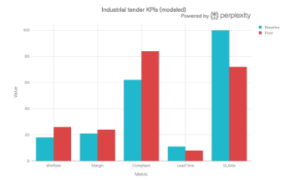
Figure 9: Modeled improvements in win rate, margin, first-time compliance, lead time, and SLA penalties.
| KPI | Before | After |
| Qualified tender win rate | 18% | 26% |
| Margin on won bids | 21% | 24% |
| First submission compliance | 62% | 84% |
| Average lead time | 10–12 weeks | 7–9 weeks |
| SLA penalty index | 100 | 72 |
07.Chart 2 – Sources of Value Creation (Modeled)
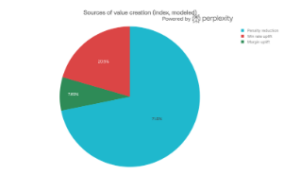
Figure 10: Modeled contribution of win-rate uplift, margin uplift, and penalty reduction to value creation.
The analysis showed that three major areas drove value creation:
- Higher tender conversion through stronger localization positioning
- Improved margin protection through buyer-specific strategies
- Reduced operational penalties through better delivery alignment
08.Strategic Insights
Build a Documented Local Capability Dossier
The client needed a structured localization evidence package covering:
- Local capabilities
- Service infrastructure
- Partner ecosystem
- Localization roadmap
- Compliance documentation
This helped procurement teams clearly evaluate the company’s regional contribution.
Create Two Bid Archetypes
The research recommended separate approaches based on buyer priorities.
Compliance-First Bid Strategy
For government-linked opportunities:
- Localization evidence
- Documentation strength
- Industrial alignment
Uptime-First Bid Strategy
For private operators:
- Delivery reliability
- Service capability
- Operational continuity
Select Partners Based on Execution Capability
Partner evaluation should focus on:
- Compliance discipline
- Delivery reliability
- After-sales performance
rather than only market reach.
Align Localization Investment With Industrial Priorities
Localization initiatives should support broader UAE and Saudi industrial objectives to improve credibility with procurement teams, government stakeholders, and strategic partners.
09.Business Impact / Outcome (Modeled)
The engagement delivered a 12–18 month localization roadmap and a refreshed bid strategy framework designed to improve the client’s competitiveness in UAE and Saudi Arabia.
By combining:
- Procurement intelligence
- Buyer research
- Tender analysis
- Localization assessment
Researchers.me helped transform market insights into an actionable strategy for improving industrial tender performance.
The approach strengthened the client’s positioning as a credible regional industrial partner aligned with evolving local-content expectations.