
01.Overview
A regulated financial services provider in the UAE offering a digital account and card solution for salaried professionals and SMEs was experiencing strong acquisition but weak customer activation.
While onboarding starts remained healthy, a large proportion of users dropped off before reaching their first funded transaction. This increased acquisition costs, reduced onboarding efficiency, and limited early product engagement.
Researchers were engaged to understand where friction existed, identify which customer segments were most likely to activate, and redesign onboarding to improve conversion while remaining fully compliant with financial regulations.
02.At a Glance
Industry: Financial Services / Fintech Region: UAE Target Audience: Salaried Professionals & SMEs Core Challenge: High onboarding drop-off and weak early customer activation Research Approach: Behavioral Segmentation + UX Research + Funnel Analytics + Support Ticket Mining Fieldwork Period: 6 January 2026 - 14 February 2026
Key Outcomes (Modeled)
Start to KYC submission improved from 71% to 82%.
KYC approval improved from 78% to 84%.
First funding improved from 52% to 63%.
First transaction within 7 days improved from 58% to 66%.
Support contacts reduced from 94 to 61 per 1,000 onboardings.
03.The Business Challenge
Despite strong top-of-funnel acquisition, the provider faced a significant challenge converting onboarding starts into active users.
A major percentage of customers abandoned the onboarding process between KYC completion and first funded transaction, creating higher customer acquisition costs and reducing the number of active users entering the ecosystem.
At the same time, the business lacked a clear understanding of
Which customer segments were most likely to activate.
Where onboarding friction was occurring.
Why users abandoned onboarding journeys.
How to simplify onboarding without affecting regulatory compliance.
The objective was to create an activation-focused onboarding strategy supported by customer segmentation and behavioral insights.
04.Research Approach
Researchers implemented a mixed-method framework combining behavioral, operational, and experience-based research to identify onboarding barriers and activation drivers.
Behavioral Segmentation Survey
A weighted survey of 1,203 digital banking users was conducted to understand onboarding motivations, financial priorities, and behavioral patterns.
Onboarding UX Study
Researchers conducted 36 moderated onboarding sessions to observe real-world user behavior, identify friction points, and map abandonment moments across the onboarding journey.
Funnel Analytics Deep Dive
Eight weeks of anonymized onboarding data were analyzed across the complete customer journey.
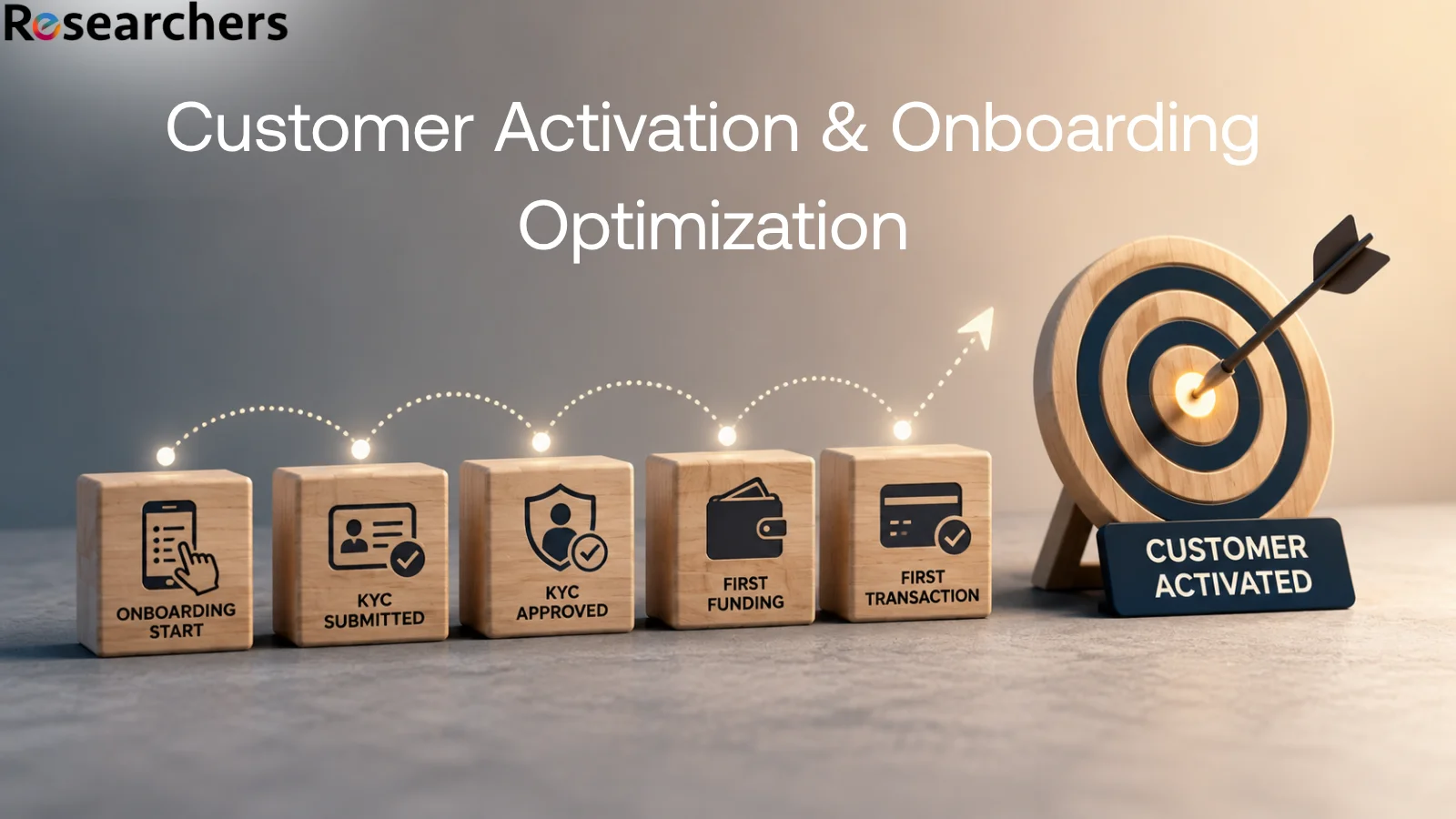
Start → KYC → Approval → First Funding → First Transaction
This helped identify where customers dropped off and which behaviors contributed to activation.
Customer Support Text Mining
Over 12,400 customer support tickets and chats were coded and analyzed to uncover recurring onboarding concerns and friction themes.
Compliance Alignment Workshop
A structured workshop was conducted to distinguish must-have compliance requirements from unnecessary onboarding complexity, helping simplify the experience without compromising regulation.
05.Key Findings
1. Activation Was Driven by Urgency, Not Wealth
One of the strongest findings was that activation behavior was influenced more by a customer's immediate financial need than by wealth or income level.
Users with urgent and clearly defined goals, such as salary deposits, bill payments, or SME-related transactions, showed significantly higher onboarding completion and stronger 30-day transaction rates.
This highlighted the importance of designing onboarding around a customer's "job-to-be-done."
2. Onboarding Friction Was Creating Preventable Drop-Off
The research uncovered several recurring friction points that slowed onboarding and increased abandonment.
Document Capture Loops
Users frequently struggled with document upload issues due to unclear instructions and poor error messaging.
Dense Consent Screens
Legal and privacy content was perceived as difficult to understand, reducing trust and increasing hesitation during onboarding.
Lack of Status Certainty
After KYC submission, many users experienced uncertainty due to unclear timelines, limited visibility, and no clear explanation of next steps.
This lack of confidence created avoidable drop-offs during a critical stage of onboarding.
3. Different Customer Segments Required Different Experiences
Behavioral segmentation identified distinct onboarding expectations among users.
Privacy Anxious Optimizers
These customers were highly sensitive to data handling and required stronger reassurance around privacy, transparency, and consent.
Time-Starved Doers
This segment preferred fast, predictable onboarding experiences and showed extremely low tolerance for friction or delays.
The findings reinforced that a one-size-fits-all onboarding experience was limiting activation.
06.Onboarding Funnel Conversion (Modeled)
Following segmentation-led onboarding redesign recommendations, modeled projections indicated meaningful improvements across key onboarding stages.

Figure 5
Baseline vs. post-redesign onboarding conversion from onboarding start to first transaction.
| Funnel Stage | Baseline | Post-Redesign |
|---|---|---|
| Start to KYC Submitted | 71% | 82% |
| KYC Submitted to Approved | 78% | 84% |
| Approved to First Funding | 52% | 63% |
| First Funding to First Transaction (7 Days) | 58% | 66% |
The largest improvement was observed between approval and first funding, where greater onboarding clarity and reduced uncertainty improved customer progression.
07.Reduction in Support Contacts
The redesigned onboarding experience was also projected to reduce onboarding-related support dependency.
Figure 6: Modeled reduction in onboarding-related support contacts per 1,000 onboardings.

Support interactions were projected to decline from the following
94 -> 61 support contacts per 1,000 onboardings
This reduction was driven by
- Better onboarding guidance
- Clearer status communication
- Improved consent explanations
- Reduced onboarding errors
08.Strategic Recommendations
Based on the findings, Researchers recommended four key interventions.
Design Around Customer Intent
- Salary-first onboarding
- Bill-payment onboarding
- SME-payment onboarding
Simplify Compliance Communication
Keep full legal documentation available while introducing plain-language summaries and visual explanations.
Make Status Certainty Non-Negotiable
- Progress trackers
- Expected completion timelines
- Proactive onboarding notifications
Treat Onboarding as a Product
Establish cross-functional ownership supported by a weekly KPI framework focused on
- Conversion rates
- Time-to-completion
- Support burden
- Activation performance
09.Business Impact
By combining customer segmentation with onboarding optimization, the provider gained a clearer understanding of activation behavior and onboarding friction.
The redesigned framework created a scalable onboarding model capable of improving customer activation, reducing operational burden, and improving acquisition efficiency.
The activation-led onboarding approach is now being used as a repeatable framework for future product launches.
Client details have been anonymized to maintain confidentiality. Outcomes shown are modeled estimates based on research findings and implementation scenarios.
Looking to Improve Customer Activation or Reduce Funnel Drop-Off?
Researchers help fintechs, financial institutions, and digital platforms identify customer friction, improve onboarding journeys, and drive better conversion through data-backed research.